
Cyber Essentials vs. DCC: How They Work Together (and Why You Need Both)
6 July 2026
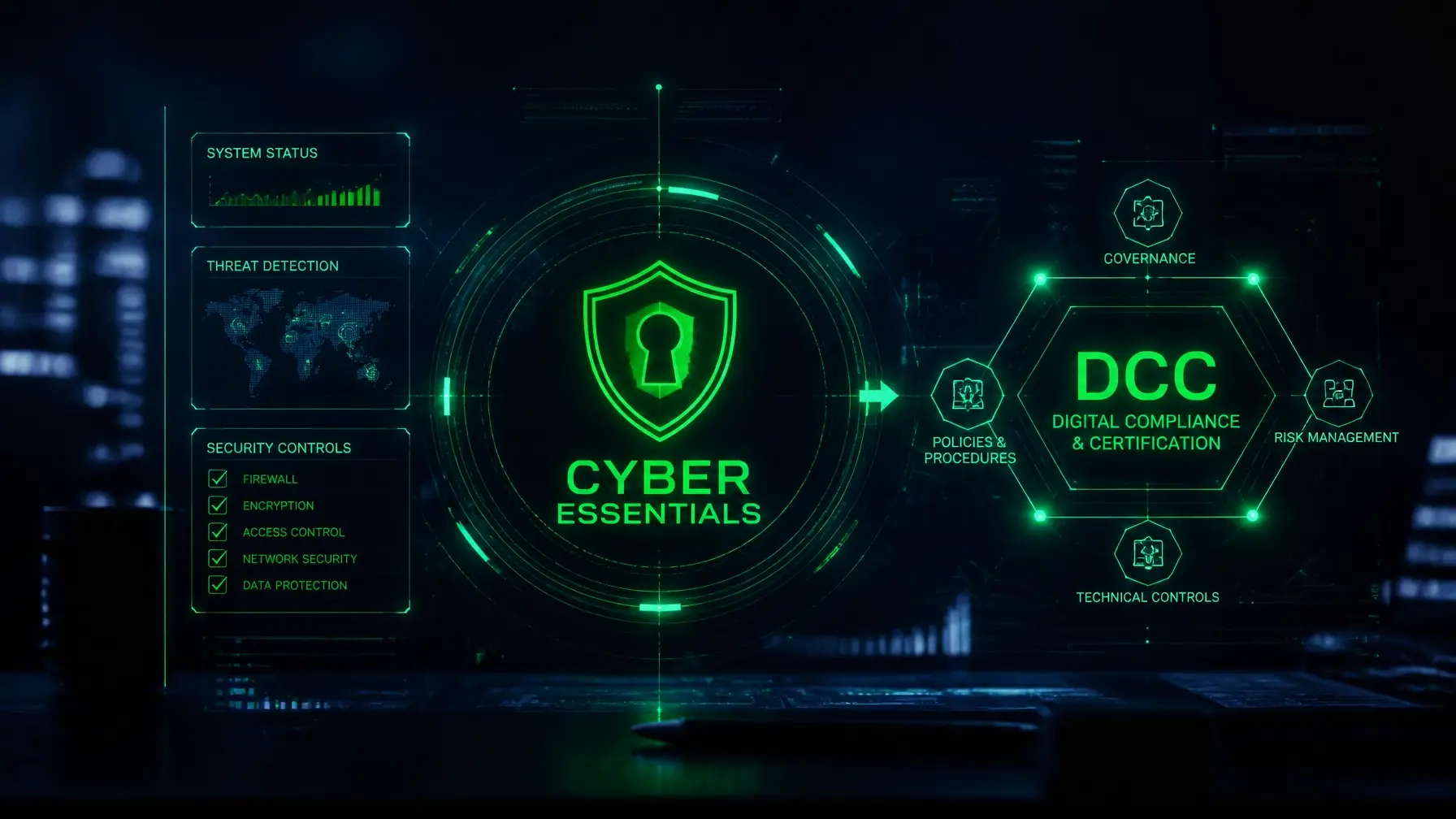
If you’re a UK SME in the defence supply chain, the goalposts just moved.
The Ministry of Defence (MoD) has introduced a new standard: Defence Cyber Certification (DCC). For many business owners, this feels like yet another layer of "red tape." You might already have Cyber Essentials (CE) and wonder why you need another badge on your website.
The truth is, it’s not an "either/or" situation. Cyber Essentials and DCC are designed to work in tandem. In fact, you can’t have one without the other if you want to keep winning defence contracts.
Here is exactly how these two certifications fit together and why the 31 December 2026 deadline should be on your radar today.
What is Cyber Essentials? (The Technical Foundation)
Think of Cyber Essentials as the "MOT" for your digital security. It’s a government-backed scheme that protects your business against the most common cyber threats: the digital equivalent of opportunistic thieves looking for an unlocked door.
Cyber Essentials focuses on five core technical controls:
- Firewalls: Securing your internet connection.
- Secure Configuration: Setting up devices and software safely.
- User Access Control: Ensuring only the right people have access to your data.
- Malware Protection: Shielding your business from viruses and "ransomware."
- Security Update Management: Keeping your software and devices patched and up to date.
For most SMEs, achieving Cyber Essentials is the first step toward professional security. It’s often a baseline requirement for any government contract, but for the defence sector, the MoD is now asking for more.
What is DCC? (The Defence-Specific Standard)
Defence Cyber Certification (DCC) is the MoD’s new, organisation-wide framework. While Cyber Essentials focuses on technical "housekeeping," DCC expands into governance, risk management, and supply chain resilience.
It replaces the old system where you had to fill out a separate Supplier Assurance Questionnaire (SAQ) for every single contract. Instead, you get one certification that covers your whole business for three years.
DCC is broken down into four levels:
- Level 0: Very low risk (3 controls).
- Level 1: Low to moderate risk (101 controls).
- Level 2: High risk (139 controls).
- Level 3: Substantial risk (144 controls).

How They Work Together: The Prerequisite Rule
The most important thing to understand is that Cyber Essentials is a mandatory prerequisite for DCC. You cannot achieve DCC without a valid Cyber Essentials certificate.
The relationship is simple:
- DCC Level 0 & 1: Require a valid Cyber Essentials certificate.
- DCC Level 2 & 3: Require a valid Cyber Essentials Plus certificate (which involves an independent technical audit).
While Cyber Essentials secures your IT infrastructure, DCC adds the "defence-grade" layers on top: like how you handle sensitive data and how you manage your own subcontractors. To keep your DCC valid, you must renew your Cyber Essentials certification every year.
The 2026 Deadline: Why SMEs Must Act Now
The MoD has been clear: they want the entire defence supply chain secured.
Industry partners have been asked to achieve at least DCC Level 0 by 31 December 2026. This includes all subcontractors and SMEs that provide services to the MoD, even if you don't think your work is "high risk."

If you wait until late 2026 to start, you’ll face a massive bottleneck. Certification bodies will be overstretched, and if your Cyber Essentials isn't in place first, you'll be stuck at the starting line while your competitors are ready to bid for new work.
Why You Need Both: Problem, Solution, Benefit
Navigating these requirements can feel overwhelming, but looking at them through a "result-oriented" lens makes the value clear.
| The Problem | The SimpleCyber Solution | The Business Benefit |
|---|---|---|
| Technical Vulnerabilities: Common cyber-attacks could disrupt your operations. | Cyber Essentials Accreditation: We guide you through the 5 core controls to lock your digital doors. | Reduced Risk: You become a "hard target," drastically reducing the chance of a costly data breach. |
| Contractual Compliance: The MoD is moving to DCC, and old SAQs are being phased out. | DCC Readiness: We help you map your existing security to the DCC levels (0–3). | Business Continuity: You remain eligible for MoD contracts and can prove your security maturity to "Primes." |
| Administrative Burden: Managing annual renewals and complex spreadsheets takes too much time. | Virtual Security Manager: We take the lead on your security strategy so you can focus on growth. | Peace of Mind: Expert-led security that scales with you, without the cost of a full-time hire. |
How SimpleCyber Can Help
We specialize in taking the "complex" out of cybersecurity. We don't do jargon, and we don't do "one-size-fits-all" security.
Our Fractional Security Consultants and Virtual Security Managers have over 20 years of experience helping UK SMEs navigate MoD requirements. Whether you are starting from scratch or need to upgrade from Cyber Essentials to DCC Level 2, we provide practical, cost-effective support.
We help you:
- Achieve Cyber Essentials/Plus: The essential first step for any defence supplier.
- Navigate DCC Scoping: Identifying which level you actually need so you don't over-spend on unnecessary controls.
- Build a Security Roadmap: Aligning your security with your business goals and the 2026 MoD deadline.

Don't Leave Your Compliance to Chance
The road to December 2026 starts with a single step: getting your Cyber Essentials foundation right. Once that is secure, DCC Level 0 and beyond become a manageable transition rather than a crisis.
Ready to secure your spot in the defence supply chain?
Contact SimpleCyber today for a straightforward, jargon-free chat about your Cyber Essentials and DCC requirements. Let’s get you certified and ready for the future.